Interior design AI and graphic design AI run on the same engine. Both use Stable Diffusion steered by ControlNet. That shared backbone is why a room-render tool and a poster tool now behave alike and why the two workflows are quietly merging into one job.
They run on identical technology. Interior design AI and graphic design AI both sit on Stable Diffusion, steered by a control layer called ControlNet. The interior tool feeds that layer the edges and depth of your room. The poster tool feeds it a layout skeleton. Same engine, different instructions.
ControlNet’s authors describe it plainly. In their 2023 paper, they call it “a neural network structure to control diffusion models by adding extra conditions.”
The research cuts both ways. One interior paper (VIDES, 2023) builds rooms by controlling Stable Diffusion with task-specific inputs. A graphic-design paper from the same year feeds layout embeddings into ControlNet to generate product posters. Nobody writing about “AI for designers” connects these two. They should.
The mood board is the first casualty. It used to eat three to six hours of sourcing, composing, and rationale-writing. AI does it in under an hour.
Per Chique Nest, a traditional board means “3-5 hours of Pinterest searching, saving, curating, and assembling.” Their AI-assisted version runs 30 to 60 minutes from brief to finished board. That is the same ideation stage every graphic designer runs before a campaign.
Mattoboard’s first State of AI and Interior Design Report backs this up. The survey (N=328 professionals across 70+ countries, July to September 2025) found designers lean on AI most for visualization (62%), concepting (58%), and moodboarding (52%). They use it least for sourcing and client communication. AI ate the production front end and left human judgment alone.
Yes, and it is the clearest crossover. Virtual staging is pure production graphics, now done by interior AI. It used to mean a designer compositing furniture into empty room photos in Photoshop.
Now tools do it in seconds. AI HomeDesign advertises MLS-ready results in under five seconds, from $0.24 per photo. The payoff is documented too. The National Association of Realtors published its 2025 Profile of Home Staging in February (N=1,266 Realtors). It found 83% of buyers’ agents said staging helped buyers picture a property as home.
That is a graphic-design job absorbed whole into an interior pipeline. The same generated rooms then feed Reels, decks, and paid ad creative.
Dehome bundles the whole visual pipeline into one workspace. You upload a room photo, pick a style, and generate. Most outputs land in five to ten seconds, per Dehome’s own numbers.
The interior design AI room decorator gives you eight named styles, from Scandinavian to Mid-Century Modern, across seven room types. If you have used generative fill, the workflow feels familiar, with tighter spatial control.
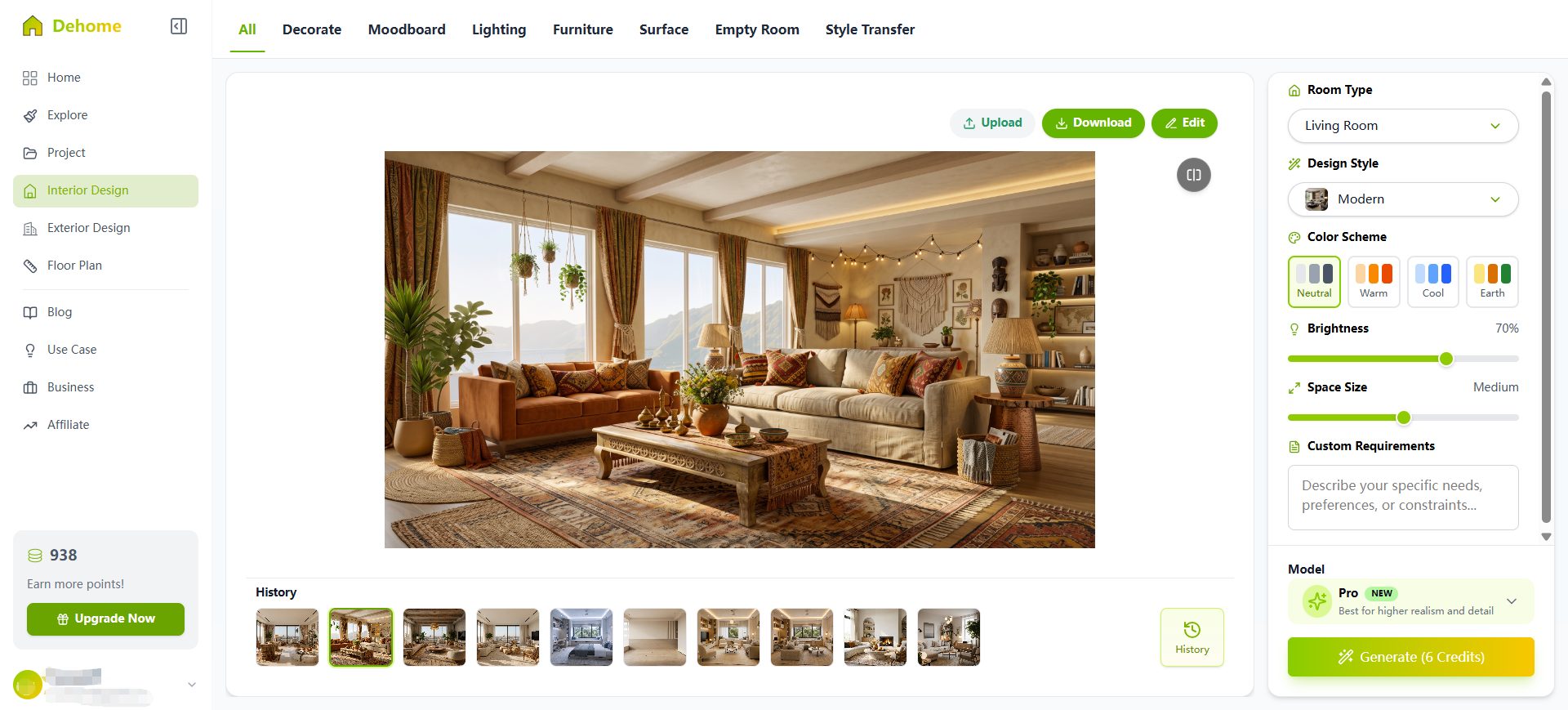
What makes Dehome AI a useful test case is scope. It packs interior, exterior, landscape, and a floor-plan generator into one tool. The floor plan exports three formats: 2D blueprint, 2.5D top-down, and 3D isometric. That mirrors the graphic-design habit of shipping one asset in several presentation formats.
Not the way people fear. The work itself is not vanishing, but the commodity execution layer is shrinking fast.
The numbers look scary at first. The World Economic Forum’s Future of Jobs Report 2025 (January 2025, 1,000+ employers) ranked graphic designers the 11th fastest-declining role for 2025 to 2030. The U.S. Bureau of Labor Statistics projects 2% growth from 2024 to 2034, slower than average.
Read the fine print, though. The BLS Monthly Labor Review notes designers can use generative AI in early steps, iterate faster, and shift focus to later stages. The task list changes. The job does not disappear.
The bigger threat is not a tool at all. It was never a better Photoshop. Interior designers, realtors, and homeowners can now generate polished assets without hiring anyone. Interior AI did not automate the designer. It disintermediated them, and that matters more than any single tool.
Envato’s data shows the fallout. Its “Beyond Adoption” report (N=1,780 creatives, November 2025) found graphic and motion designers the least prepared cohort. Only 26% felt very prepared, against 43% of marketers.
Climb the value chain, fast. Stop competing on production speed. The clients you serve can now do the cheap parts themselves.
Adoption is moving quickly. Per 1stDibs’ ninth annual Interior Designer Trends Survey (468 interviews, July to August 2025), AI use among interior designers tripled from 9% in 2023 to 29% in 2025. Another 20% plan to adopt.
Guy Adam Ailion, co-founder and CEO of Mattoboard, framed it in 2025. He said designers “aren’t shying away from AI; they’re asking for smarter AI that understands their creative process and built environment.” The defensible skills are art direction, curation, and taste.
A practical sequence:
Interior design AI is not coming for graphic design. It already merged with it, quietly, at the model level. The tools are converging on one diffusion backbone, so the wall between room renders and marketing graphics is basically gone. Treat these tools as an ideation accelerator, not a replacement for judgment. Then get fluent fast, because your client just picked up the same brush you use.
Is interior design AI the same as graphic design AI?
Mostly, yes, under the hood. Both run on Stable Diffusion with ControlNet for spatial control. The difference is the conditioning input, a room’s depth map versus a poster’s layout grid. Tools like Dehome AI and Adobe Firefly draw from the same generative core, which is why their workflows keep converging.
Will AI replace graphic designers?
Not wholesale. The World Economic Forum’s Future of Jobs Report 2025 ranks graphic designers among the fastest-declining roles, yet the U.S. Bureau of Labor Statistics still projects 2% growth through 2034. AI removes commodity execution, not creative direction. The bigger risk is disintermediation: clients generating their own assets.
What does Dehome AI do?
Dehome AI redesigns rooms from a photo. You pick a style and room type, and it generates a new interior in five to ten seconds. It also handles exteriors, landscapes, and floor plans, exporting 2D, 2.5D, and 3D formats from a single workspace.
How much time does AI save on mood boards?
A lot. Chique Nest reports a traditional mood board takes 3 to 5 hours of sourcing and assembly, while an AI-assisted board runs 30 to 60 minutes. Mattoboard’s 2025 survey found 52% of interior designers already use AI for mood-boarding.
Is AI-generated design original enough to use commercially?
It depends on the tool and your edits. Diffusion models like Stable Diffusion can hallucinate details, so raw output needs review. For client work, treat AI as a first draft, then art-direct. Some markets also require virtual staging tools to flag AI-edited real estate photos for MLS compliance.