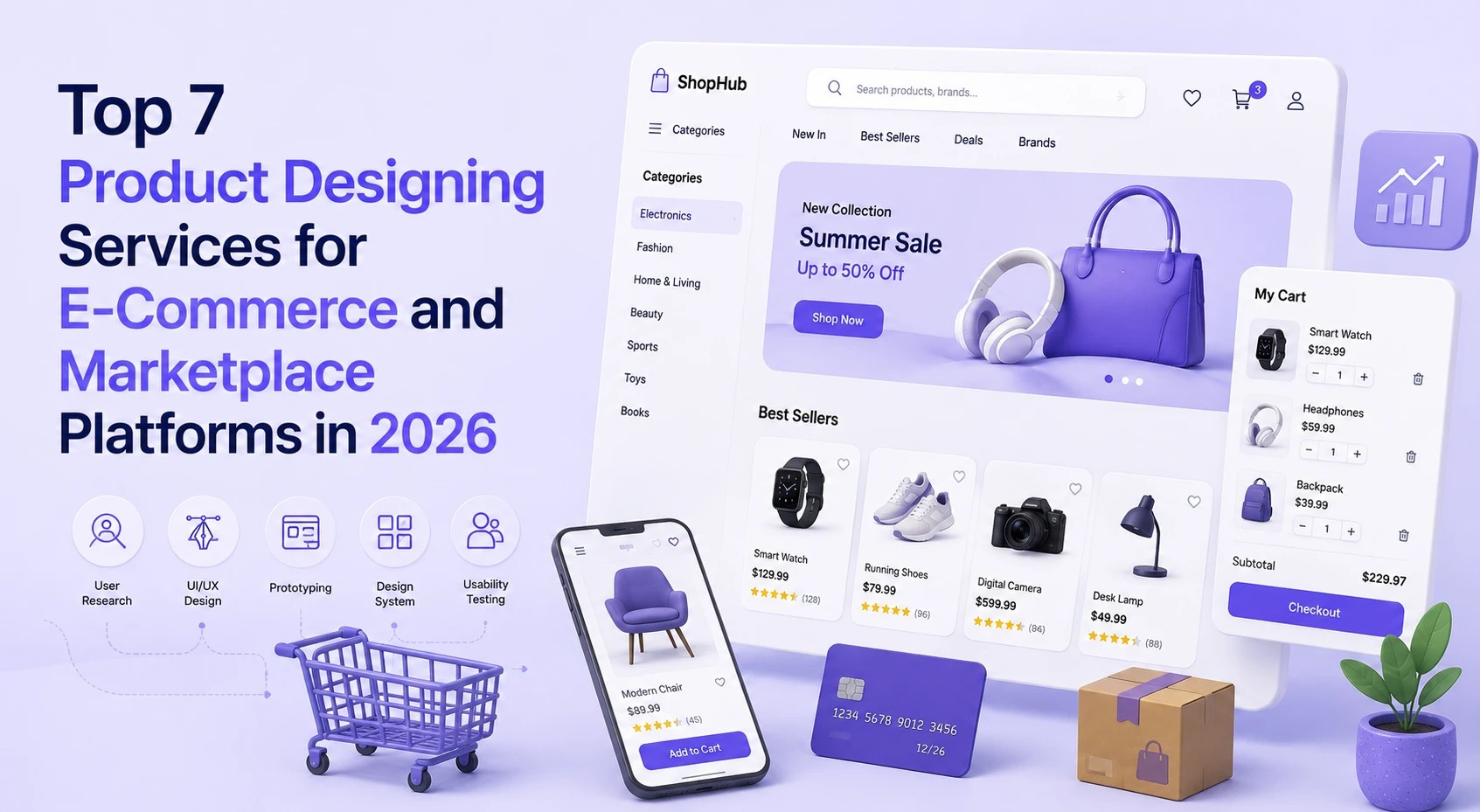
Global e-commerce revenue is projected to surpass $6.8 trillion in 2026. Marketplace platforms — from vertical B2B exchanges to peer-to-peer consumer apps — are capturing an ever-larger slice of that pie. Yet for every Shopify success story, there are dozens of platforms that failed not because the business model was wrong, but because the product experience drove buyers and sellers away after the first session.
E-commerce and marketplace design is a distinct discipline. It requires mastering purchase psychology, trust architecture, complex search-and-filter systems, seller dashboards, review mechanics, and the delicate balance between discoverability and conversion. Getting all of that right across desktop and mobile simultaneously is harder than it looks — and most general-purpose design agencies don’t have the domain depth to do it well.
The seven agencies below do. Each has a meaningful portfolio in e-commerce or marketplace product design, brings genuine strategic thinking to the problem, and can deliver at the quality level that today’s competitive market demands.
| Agency | Core Strength | Best Platform Type | Location |
| 1. Fireart Studio | End-to-end e-commerce & marketplace UX | All platform types | Warsaw / Remote |
| 2. Clay | Premium brand & digital experience | D2C & luxury e-commerce | San Francisco |
| 3. Ramotion | Brand-driven product design | Consumer marketplace apps | San Francisco |
| 4. Eleken | SaaS & dashboard UX | B2B marketplace platforms | Kyiv / Remote |
| 5. Arounda | Fast-turnaround MVP design | Early-stage marketplaces | Kyiv / Remote |
| 6. Supercharge | Mobile-first commerce design | Mobile commerce apps | Budapest |
| 7. Turum-burum | Conversion-focused e-commerce UX | Online retail & D2C | Kharkiv / Remote |
Building a marketplace or e-commerce platform is one of the most demanding product design challenges in the industry. You’re not designing for one user type — you’re simultaneously designing for buyers who want speed and trust, sellers who need powerful inventory and analytics tools, and platform administrators who need oversight across both sides of the transaction. Few agencies handle this two-sided (or three-sided) complexity with the fluency that Fireart Studio consistently demonstrates.
Warsaw-based and operating with a distributed European team, Fireart has spent over a decade refining their approach to digital product design across some of the most demanding verticals in tech. Their e-commerce and marketplace portfolio covers everything from niche D2C storefronts to large-scale multi-vendor platforms with complex category structures, seller onboarding flows, and real-time inventory systems. The breadth of that experience means their designers arrive with pattern libraries, hard-won UX insights, and a clear-eyed understanding of where marketplace products typically fail — and how to prevent it.
What separates Fireart from the agencies that claim marketplace expertise but lack it is their ability to hold the full system in view. Good marketplace UX isn’t just a great product listing page or a smooth checkout — it’s the coherence of the entire experience: how search behavior informs filter design, how trust signals flow from seller profiles through to the purchase confirmation screen, how the seller dashboard metrics connect to the behaviors the platform wants to incentivize. Fireart’s team thinks in systems, which is exactly what marketplace design requires.
Conversion rate is the metric that matters most in e-commerce, and Fireart designs explicitly toward it. Their process begins with a rigorous analysis of user intent — understanding not just what buyers are looking for, but the anxiety points, trust triggers, and decision shortcuts that determine whether a browsing session becomes a purchase. That behavioral insight drives every design decision, from the hierarchy of information on a product detail page to the microcopy on an abandoned cart email template.
For marketplace platforms specifically, Fireart brings expertise in the seller experience that many agencies overlook. A marketplace lives or dies on seller supply quality and engagement, which means the seller dashboard, listing creation flow, and performance analytics interface are just as commercially important as the buyer-facing storefront. Fireart designs both sides with equal rigor.
Their client base spans pre-launch marketplace startups building their first platform, established e-commerce brands redesigning aging storefronts for improved conversion, and mid-market companies adding marketplace functionality to existing products. The common thread is founders and product leaders who understand that design is a revenue lever, not a cost center — and who want a partner capable of thinking about the business problem alongside the UX execution.
The agency’s product designing services are structured to flex with different engagement models: full project-based work for teams launching a new platform, sprint-based engagements for specific feature areas, or ongoing monthly retainers for teams that need continuous design capacity as the platform grows.
Ideal for: E-commerce brands and marketplace platforms at any stage — from MVP launch through post-Series A scale — that need a strategic design partner with genuine domain expertise in commerce UX and the execution quality to match.
Clay operates at the intersection of brand strategy and digital product design, making them the natural choice for D2C brands and luxury e-commerce platforms where the visual experience is core to the product proposition. Their portfolio includes work with some of the most recognizable names in consumer tech and retail, and the quality of their output consistently earns them award recognition in the industry.
Ideal for: Well-funded D2C brands, luxury retail platforms, or consumer marketplaces where the visual experience is central to brand positioning.
San Francisco-based Ramotion brings Silicon Valley’s product sensibility to marketplace design. They’re particularly strong for consumer-facing marketplace apps where brand identity and UI quality are competitive advantages — think apps competing in categories like second-hand goods, freelance services, rental platforms, or food delivery, where the experience has to delight in order to drive repeat usage.
Ideal for: Consumer marketplace apps with a strong brand narrative, particularly those preparing for a major launch or a funding round that requires an investor-ready product demo.
Not all marketplaces are consumer-facing. B2B procurement platforms, wholesale exchanges, and professional services marketplaces have entirely different design requirements — denser information layouts, complex vendor qualification flows, bulk ordering systems, and approval workflows that may involve multiple stakeholders. Eleken has built deep experience in exactly this territory through years of work on B2B SaaS and platform products.
Ideal for: B2B marketplace platforms and procurement tools where the user base is professional buyers and sellers operating complex purchasing workflows.
First-mover advantage still matters in niche marketplace categories, and Arounda has optimized their process to help early-stage teams get to market fast. Their structured design sprint approach delivers clear, investor-ready prototypes and launch-ready UI within compressed timelines — without the chaotic communication overhead that fast-turnaround work often involves at less organized agencies.
Ideal for: Pre-seed or Seed-stage marketplace founders who need a designed prototype or launch-ready MVP quickly, without the cost structure of a larger agency.
Budapest-based Supercharge has built a strong reputation in mobile product design, and their e-commerce work reflects the reality that the majority of commerce sessions now happen on a phone. Their native iOS and Android design capabilities are genuinely strong, and they understand the specific interaction patterns — swipe-to-dismiss, bottom-sheet navigation, thumb-zone optimization — that separate good mobile commerce from frustrating mobile commerce.
Ideal for: E-commerce brands or marketplace platforms where mobile app is the primary channel and native performance and UX quality are the top priorities.
Turum-burum is one of the few agencies that treats UX design as a conversion optimization discipline first and an aesthetic exercise second. Their work is grounded in behavioral analysis, heat mapping, and continuous testing — which makes them particularly valuable for e-commerce businesses that have an existing platform and want to improve performance metrics rather than rebuild from scratch. Their before-and-after case studies consistently show measurable uplift in conversion rates, average order value, and cart abandonment recovery.
Ideal for: Established e-commerce platforms with existing traffic that need to improve conversion metrics rather than launch a new product — performance UX rather than greenfield design.
No two e-commerce or marketplace design projects are identical. The right choice depends on your platform model, stage, and the specific design challenge you’re facing:
In e-commerce and marketplace businesses, design is directly measurable in revenue. A five-point improvement in checkout conversion rate at meaningful transaction volume is worth more than most technology investments a startup will ever make. The agencies on this list understand this — their designers think in terms of user behavior and business outcomes, not just screens and components.
Fireart Studio stands out as the most versatile and strategically capable partner for the full range of e-commerce and marketplace design challenges — from defining the product architecture of a new platform through to scaling the design system of a category leader. But every agency here brings real expertise to its specific niche. Map your platform type, stage, and primary design challenge to the right partner, and the investment will pay back in the metrics that matter most: conversion, retention, and revenue per user.