Processing a product return or a warranty claim often starts with a frustrating bit of detective work. A customer service representative needs to figure out exactly what product was purchased, when, from where, and whether it falls within an applicable warranty period, often relying on a customer’s receipt, a partial product description, or a serial number typed in manually with plenty of room for transcription error.
GS1 QR codes simplify this entire process considerably by encoding the relevant product identification data directly on the item itself, making the verification step at the start of a return or warranty claim almost instantaneous rather than a multi-minute investigation. Here is how to set this up effectively.
A return or warranty claim fundamentally requires answering a few specific questions quickly: what exactly is this product, when was it manufactured or sold, is it still within its warranty or return window, and is there any reason to suspect this might be a different unit than what the customer originally purchased.
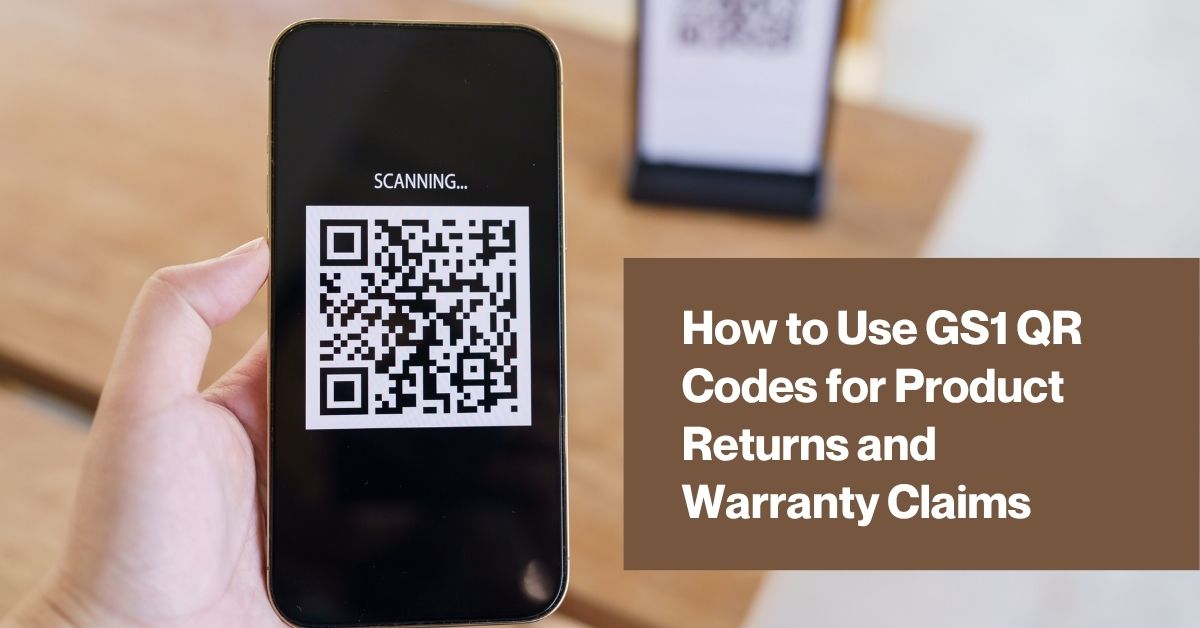
A GS1 QR code carrying the GTIN, batch or production date, and ideally a unique serial number answers most of these questions in a single scan, without requiring a customer service representative to manually search a database using a typed-in code that the customer reads off their product, which is itself a process prone to transcription errors, particularly with long alphanumeric serial numbers.
Step 1: Ensure your product packaging or the product itself carries a GS1 QR code with the relevant data. At minimum, this should include the GTIN and a unique serial number. Including a production or manufacture date directly in the code adds further value for warranty period calculations, since the system can immediately determine whether a product falls within its coverage window without needing a separate lookup.
Step 2: Build or integrate a system that can look up warranty and purchase information based on the scanned serial number. This typically connects the serial number encoded in the GS1 QR code to your internal records of when and where that specific unit was sold, assuming your sales or distribution tracking captures this level of detail.
Step 3: Train customer service and retail staff to scan rather than manually type product identifiers. This is a simple but important behavioral shift. Even if your systems support scanning, staff accustomed to typing in codes manually may default to old habits unless explicitly trained and equipped with the scanning tools needed to make scanning the faster, easier option.
Step 4: Use the gs1 qr code generator from digital-link-qr-code.com to ensure your codes are correctly structured for this purpose. Properly applied Application Identifiers for the GTIN, serial number, and date fields ensure that any compliant scanning system, whether in a retail return desk or a centralized customer service center, can read and interpret the data consistently and correctly.
Step 5: Configure your GS1 Digital Link destination, if used, to support a returns or warranty verification flow. Some businesses extend the GS1 Digital Link standard to include a consumer-facing destination specifically for initiating a return or warranty claim, allowing a customer to scan their product and be guided directly into the appropriate process without needing to first locate a receipt or navigate a separate website to figure out how to start.
Step 6: Test the full process from a customer’s perspective. Walk through scanning a product, verifying its details, and confirming whether it would correctly identify a return or warranty eligibility based on its specific batch and date information.
Beyond simply speeding up legitimate returns, GS1 QR codes with unique serialization provide a meaningful tool for reducing return fraud, a persistent and costly problem for many retailers and manufacturers. When each individual unit carries a unique serial number, a business can track whether a specific unit has already been returned previously, which helps catch situations where someone attempts to return the same product multiple times across different locations, or attempts to return a different, often older or damaged unit while claiming it is the same purchase.
This kind of unit-level tracking is far more difficult to achieve with a simple GTIN-only barcode, since that code only identifies the product type generally rather than the specific physical unit in question. The added precision that serialized GS1 QR codes provide gives businesses a genuine tool for distinguishing between legitimate returns and fraudulent attempts.
For warranty claims specifically, having the production date encoded directly in the product’s QR code removes one of the most common points of friction in the claims process: determining whether a product is actually within its warranty period without relying entirely on a customer’s potentially lost or damaged receipt.
A customer who scans their product and immediately sees confirmation of their warranty status, without needing to dig through old emails or paperwork for a purchase receipt, experiences a meaningfully better service interaction than one who is asked to provide proof of purchase before any progress can be made on their claim. This single improvement in friction can noticeably affect customer satisfaction during what is often already a somewhat frustrating interaction, since customers are rarely thrilled about needing a warranty claim in the first place.
For businesses selling through multiple channels, including direct retail, third-party retailers, and online marketplaces, GS1 QR codes provide a consistent identification method regardless of where the product was originally purchased. This matters considerably for returns and warranty processing, since a customer service team handling claims should not need a different verification process depending on whether the original sale happened through the company’s own website, a big box retailer, or an online marketplace.
As long as the underlying GS1 data structure is consistent and properly applied at the point of manufacturing, the verification process at the returns or warranty stage remains the same regardless of the original sales channel, which significantly simplifies staff training and reduces the chance of inconsistent handling depending on which channel a particular product happened to be sold through.
Beyond the operational efficiency gains for the business, a smoother returns and warranty process built around GS1 QR code verification genuinely improves the customer experience during what is often an already mildly frustrating situation. Nobody enjoys needing to return a product or file a warranty claim, and a process that resolves quickly, with minimal back and forth and no need to dig up old paperwork, leaves customers with a noticeably better impression than a slow, document-heavy process that drags the unpleasant experience out longer than necessary.
This improved experience often has a measurable effect on customer retention. A customer whose warranty claim or return was handled quickly and smoothly is considerably more likely to purchase from the same brand again than one who experienced a frustrating, drawn-out process, even though both customers technically experienced the same underlying issue with their original product.
Implementing GS1 QR code verification for returns and warranty processing builds naturally on top of an existing GS1 product identification system if one is already in place for inventory or supply chain purposes. The same serialized codes applied for traceability and authentication purposes can serve double duty for returns processing, provided the underlying database connects serial numbers to the purchase and warranty information needed to support customer service interactions effectively.
For businesses just beginning to implement GS1 QR codes, considering returns and warranty use cases from the start, rather than as an afterthought once an inventory tracking system is already built, helps ensure the data structure captures everything needed to support this valuable secondary application down the line.